EV route planning
Routes for electric driving.
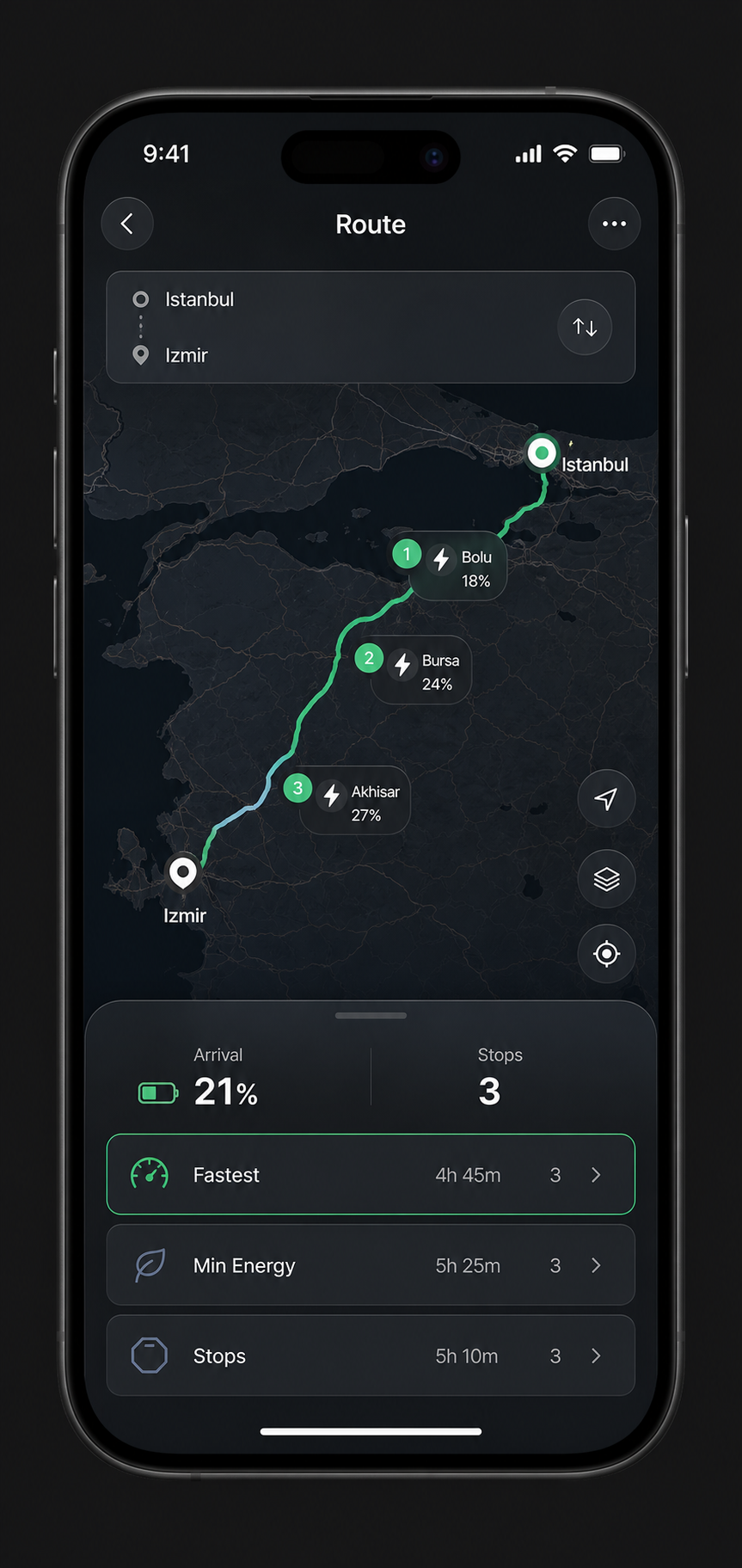
Distance, drive duration, charge duration, charge-stop count, energy, cost in TRY, arrival SoC, traffic, weather, elevation, and route rationale.
Feature system
Orontes Drive is an iOS-first EV navigation platform for Turkey. It is not a generic maps clone and not only a Tesla remote app. It sits where route planning, charging decisions, vehicle awareness, road-safety context, and Ghost AI meet.
Main pillars
EV route planning
Distance, drive duration, charge duration, charge-stop count, energy, cost in TRY, arrival SoC, traffic, weather, elevation, and route rationale.
Charging intelligence
Station name, network, plug types, power, arrival and target SoC, price, estimated cost, availability hints, amenities, feedback, and route alignment.
Map-first navigation
Orontes keeps EV route and charging logic central while overlaying Apple route notices, ETA, toll, highway, lane, and road-name context.
Hybrid search
Apple local search, backend ranking, fallback, local charger cache, route/map seeding, Turkey-wide catalog warmup, and Home/Work shortcuts.
Ghost AI
Route planning, route changes, charger swaps, Tesla commands, favorites, notifications, report submission, app actions, confirmation, and disambiguation.
Tesla connection
OAuth with PKCE, identity, offline access, vehicle data, location, command, and charging scopes, plus VIN-decoded specifications and vehicle switching.
Live vehicle intelligence
Battery, range, speed, charge state, temperatures, odometer, tire pressure, freshness, source quality, OBD-primary behavior, and Tesla fallback.
Bluetooth OBD
Real Bluetooth OBD source, mapped and unmapped stream inspector, validated push-enhapi subscription flow, and richer live driving values.
Road safety
6,441 normalized Turkey radar records, including fixed cameras, section-control cameras, traffic-light cameras, mobile cameras, and 516 corridors.
Trip replay
Route snapshots, location samples, telemetry frames, weather frames, navigation state, backend context, in-app replay, GPX, and .testrip.json export.
Live Activities
Route name, next instruction, lane hint, reroute state, battery, ETA, delay delta, remaining distance, and overlay banners for radar, charging, assistant, connectivity, and safety.
Personalization
Home and Work, favorite routes, preferred charging stops, saved route IDs, trip blacklists, favorite stations and networks, station reactions, and voice shortcuts.
CarPlay architecture
The native source tree includes main, dashboard, and instrument-cluster CarPlay scene support with trip preview, navigation sessions, route alternatives, travel-estimate updates, lane guidance, reroute alerts, and synchronized map settings. Public launch language stays careful until entitlement and release validation are cleared.
Detailed inventory
EV-aware routes, fastest/fewest-stops/min-energy alternatives, projected arrival SoC, charging sequence, drive and charge duration separation, TRY cost, traffic, weather, elevation, corridor character, final approach, charger swaps, Home/Work, and favorite routes.
Charger search, station favorites, favorite networks, trip/day/permanent hides, brand blacklists, crowd reports for broken, slow, and too-busy chargers, route-aligned selection, availability hints, plug compatibility, max DC power ranking, and charging-station reachability layers distinct from the personal range map.
Turn-by-turn guidance, road and intersection names, lane guidance, speed limits, active section control, next charging stop context, destination SoC, reroute suggestions, and Apple route overlay context.
Voice route questions, route changes, charger swaps, route disambiguation, confirmation flows, favorite management, notification toggles, crowd reports, Tesla command execution, native app actions, voice shortcuts, gaze, gesture, and visual assistant states.
Tesla OAuth, linked inventory, active vehicle switching, VIN decoding, vehicle specifications, profile inference, Tesla telemetry fallback, Bluetooth OBD priority, feed-state indicators, and command dispatch without routine wake-up abuse.
Trip history, completed summaries, replayable captures, GPX export, .testrip.json debug capture export, recorded telemetry playback, recorded weather playback, and support-friendly portable artifacts.
Charging complete, radar approach, route deviation, trip summary notifications, Lock Screen and Dynamic Island Live Activities, ETA, battery, reroute state, and overlay banners.
iOS-first, Swift 6.2+, iOS 26+ target contract, MV-first SwiftUI, local-first SwiftData, MapKit, ActivityKit, WidgetKit, AVFoundation, speech/audio coordination, SceneKit Ghost presentation, and TR/EN localization direction.
Identity, routing, vehicle, radar, assistant, trip, notification, charger, profile, and incident services, supported by Photon, Valhalla, OSRM legacy/bootstrap paths, Postgres, Redis, and NATS.
Roadmap direction
These themes are intentionally framed as roadmap-aligned expansion, not launch promises.
Deeper battery analytics and battery health modeling.
Richer climate control surfaces and vehicle automation alerts.
Drive, charge, and idle analytics for more complete ownership context.
Profiler-style telemetry dashboards and broader premium connected-vehicle layers.
FAQ
Orontes Drive is an iOS-first EV navigation app built for Turkey. It combines route planning, charging-stop intelligence, Tesla connection, Ghost AI assistance, road-safety context, and trip-aware driving tools.
No. Tesla is a deep integration layer, but Orontes Drive is positioned as an EV navigation platform first, with route planning, charging intelligence, favorites, safety context, trip history, and assistant workflows beyond Tesla alone.
A normal map app is usually optimized for fastest arrival. Orontes Drive is optimized for electric driving, which means battery, charging stops, projected arrival SoC, charger quality, route conditions, and vehicle-aware context matter.
Yes. The product models charging-stop selection with stop sequence, route fit, target SoC, estimated duration, availability hints, and charger-specific rationale.
Yes. Projected arrival SoC is part of the route model and active navigation context.
Ghost is the app's AI copilot for route-aware conversation and action flow, including trip questions, route changes, charging-stop swaps, Tesla-related commands, shortcut handling, and selected in-app actions.
Ghost is grounded in trip, vehicle, charging, radar, road-safety, navigation, memory, and app state. It is designed to be concise, relevant, and useful while driving.
Yes. The assistant tool layer supports route planning, route changes, and charging-stop swaps with confirmation and disambiguation where needed.
Yes. It can trigger native in-app actions such as opening first-party sheets, recentering the map, cycling map style, and opening known radar or station detail surfaces.
Yes. Tesla account linking uses a secure OAuth flow with PKCE, and linked vehicles can be surfaced inside the app.
It helps Orontes Drive understand linked vehicles, improve route and vehicle context, surface inventory, support in-app commands, and align profile inference with Tesla-specific vehicle information.
Yes. The product includes source-aware telemetry handling with Tesla and Bluetooth OBD feed states.
Bluetooth OBD can deliver deeper live-state fidelity than cloud-only polling, and Orontes treats OBD as the preferred live feed when available and valid.
Charger-aware search, route-side and detour-aware stop selection, station preferences, blacklists, issue reports, availability hints, power context, and cost-aware trip logic.
Yes. Radar and section-control intelligence are part of the product, including thousands of normalized Turkey radar-related records across enforcement types.
Yes. Home and Work are modeled as first-class favorite places, alongside favorite routes, favorite stations, favorite networks, and voice shortcuts.
Yes. Completed trips can be replayed in-app, exported as GPX, and exported as .testrip.json debug captures.
Yes. The native app includes Live Activity surfaces for Lock Screen and Dynamic Island with trip-relevant context such as instructions, ETA, battery, reroute state, and overlays.
The native source includes substantial CarPlay architecture, including main, dashboard, and instrument-cluster scene support. Public language should frame it as internal/native capability under validation until release gates clear.
Yes. Turkey-first direction appears across route/search architecture, radar data strategy, and overall product positioning.
Next step
Join early access and tell us which parts matter most: charging stops, Tesla connection, Ghost, radar awareness, trip replay, or all of the above.